Preparing for the future
How will we live in the future? Which professions will still be future-proof? AI has long since overtaken our assumptions. While education still thinks in old patterns, ChatGPT and the like force us to rethink the concept. Because the simple retrieval of factual knowledge is being taken over by AI, pedagogy must reorient itself — away from pure knowledge transfer, towards the development of competencies.
Montessori in a World with AI
Gathering facts, drafting texts, solving equations — soon a machine will do all of this better than any human. Once everything is available at the push of a button, specifically human competencies move into focus: empathy, intuition and moral awareness, alongside cognitive competencies such as creativity, resilience and cognitive flexibility. This is exactly where Montessori already has the answers we need today.
Future Competencies We Practise Every Day
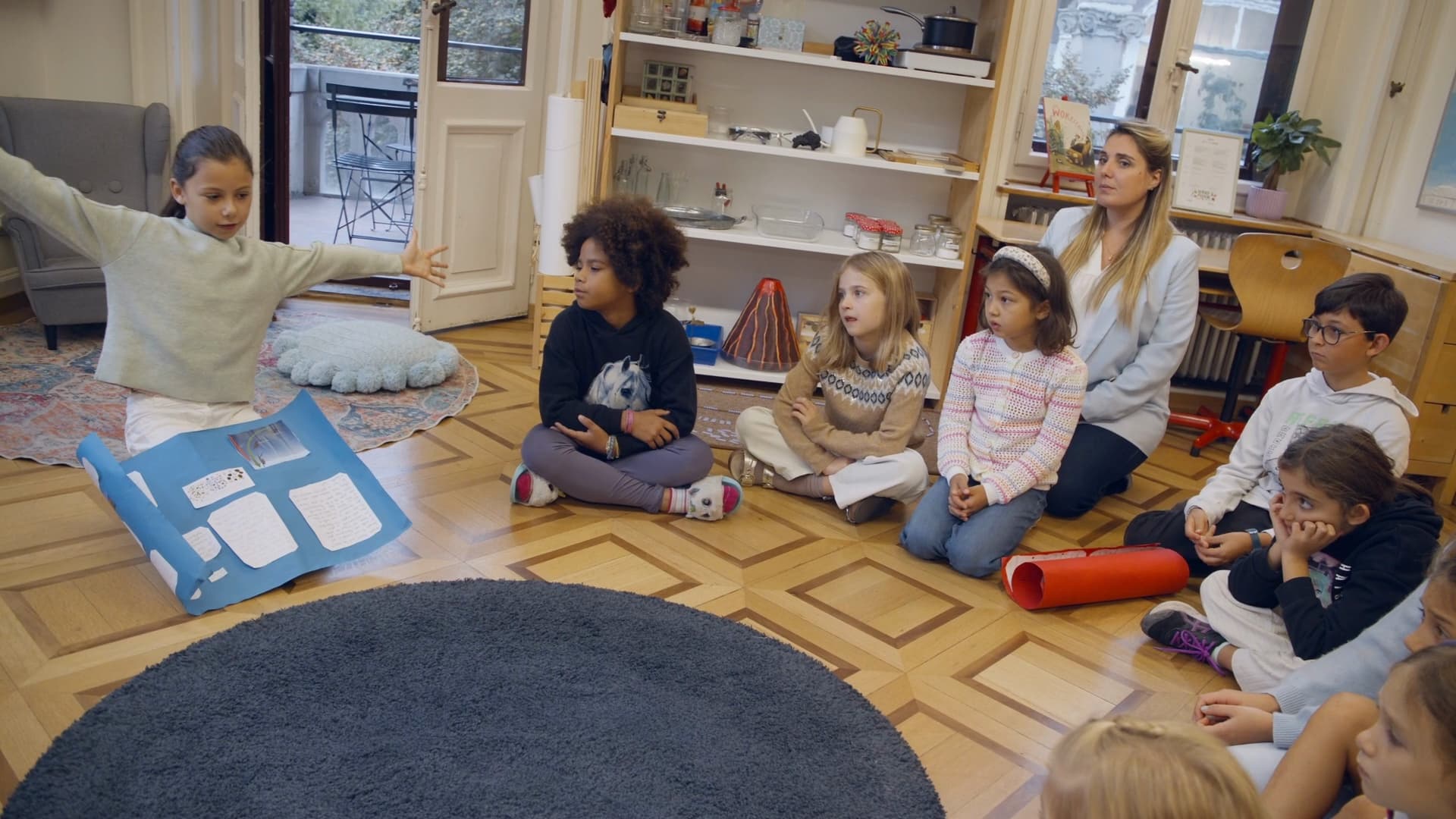
With us, children are not lectured — they are allowed to discover on their own. They learn to understand knowledge not separated by subjects, but in larger contexts — because only those who see the “big picture”, grasp complex relationships and recognise patterns an AI cannot link will hold their own against AI. Traditional education, by contrast, still relies on memorising and testing isolated knowledge — and that is exactly what AI can do far faster and better.
Intrinsic Motivation vs. Prompts and Algorithms
Our children learn to make decisions independently, to think and act for themselves, and to see mistakes as a challenge: they simply enjoy learning — crucial abilities in the world of tomorrow. Because where routines get automated, the people who succeed are those who show initiative, pursue deep interests and can acquire new knowledge in a self-directed way. Anyone who only does what they are told becomes replaceable by an algorithm.
Joy in Lifelong Learning
Artificial intelligence is reactive — it does what it is told. It has no will of its own, no curiosity. The most important skill of the future is therefore not to hoard knowledge, but the joy of learning itself — an interest in the subject matter rather than in the evaluation of one’s own performance (grades). Montessori children experience learning from the very start as something they shape themselves, and carry that feeling with them — for a lifetime.